Government jobs in Canada have a reputation among newcomers as being both highly desirable and nearly impossible to break into — the truth is somewhere in between. The process runs on a different clock than private-sector hiring, the timelines are longer, and citizenship requirements do restrict some roles, but there are real, well-documented entry points for permanent residents willing to learn how the system actually works.
Federal vs Provincial vs Municipal Government Jobs — How Hiring Differs
“Government job” in Canada actually spans three distinct hiring systems, each with its own portal, process, and eligibility rules:
| Level | Hiring Portal | Typical Citizenship Requirement |
|---|---|---|
| Federal | GC Jobs (jobs.gc.ca) | Varies by role — some require citizenship, many are open to PR |
| Provincial | Province-specific portals (e.g. Ontario Public Service careers) | Generally open to PR holders, citizenship rarely required |
| Municipal | City-specific career sites | Almost always open to PR holders |
Provincial and municipal government roles are, in practice, considerably more accessible to newcomers than federal positions, both because citizenship restrictions are rarer and because hiring volume is higher relative to the applicant pool. Federal roles get disproportionate attention from newcomers because of pension and job-security reputation, which also means federal competitions are typically more crowded.
Provincial and municipal governments also almost universally offer defined benefit or strong defined contribution pension plans as well — the compensation advantage of government work isn’t unique to the federal level, which is another reason to widen your search beyond GC Jobs alone.
How to Use the GC Jobs Portal Step by Step
The federal government’s central hiring system is GC Jobs. The practical process:
- Create a GC Jobs profile and set up job alerts filtered by classification group (e.g., AS, PM, EC) and location — generic keyword searches miss most postings, since federal job titles use internal classification codes rather than plain-language titles.
- Read the “statement of merit criteria” on every posting closely — federal applications are screened against this list almost mechanically, and failing to explicitly address each required qualification in your application (not just your resume) is the single most common reason qualified candidates get screened out before an interview.
- Apply to pools, not just single postings — many federal postings create a qualified pool used to staff multiple positions over the following months, so a single application can lead to offers well after the original posting closes.
- Expect a multi-stage process: written assessment, potentially a second-language evaluation, interview, and reference checks, often stretched over several months.
Security Clearance and Citizenship Requirements (What PR Holders Can and Can’t Apply For)
Not every federal job requires citizenship — many are open to “persons legally entitled to work in Canada,” which includes PR holders, though postings will state this explicitly under “who can apply.” Where citizenship becomes a hard requirement is typically tied to security clearance level: roles requiring Secret or Top Secret clearance, national security work, and certain policy or Cabinet-adjacent positions generally do require Canadian citizenship, following federal security screening standards.
A basic “Reliability Status” security screening — required for most federal jobs — does not require citizenship, only sufficient Canadian residency history to conduct background checks, which can itself be a challenge for very recent newcomers. If your goal is federal employment, checking each posting’s specific citizenship and security requirements before applying saves significant wasted effort, since blanket assumptions in either direction (that all federal jobs require citizenship, or none do) are both wrong.
Why Government Hiring Timelines Are Slower — What to Expect
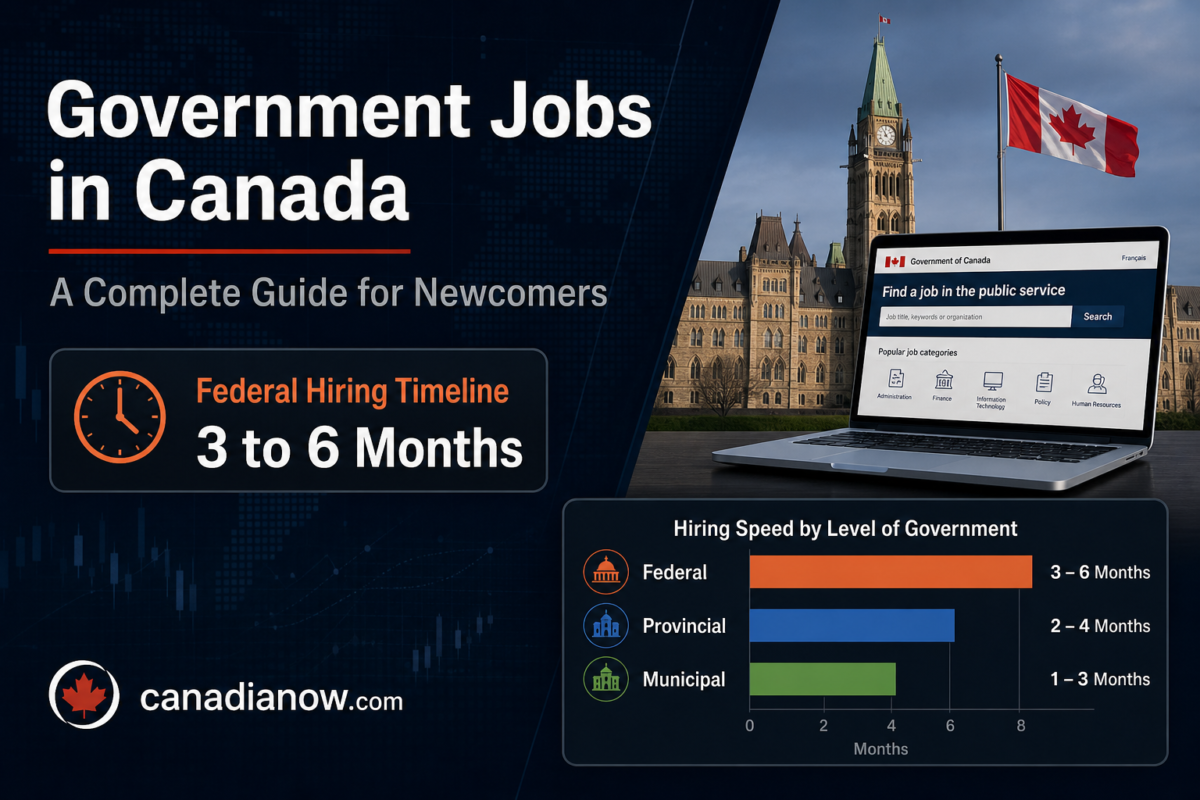
Government hiring, at every level, moves slower than private-sector hiring, and setting expectations correctly matters for newcomers who need income sooner rather than later. Federal processes in particular can run three to six months from application to offer, sometimes longer for pooled competitions or roles requiring security clearance. This isn’t dysfunction — it reflects a structured, merit-based process with multiple mandatory checkpoints (language testing, official assessments, reference verification) that private employers often skip or compress.
The practical implication: government positions work better as a medium-term goal pursued alongside more immediate private-sector employment, rather than a first-job strategy for newcomers who need to start earning within weeks of landing.
A strategy many successful newcomers use: take a private-sector role in your field within your first months for income and Canadian references, while applying to government pools in parallel. Because federal pools stay active for months, an application submitted early in your job search can still result in an offer well after you’ve already started somewhere else — at which point you simply choose whichever opportunity fits better.
Best Entry Points for Newcomers Without Canadian Government Experience
A few solidly accessible entry points exist even without prior government experience:
- Entry-level and administrative classifications (such as CRA’s regularly posted entry-level roles — see our guide on current CRA hiring) often weigh transferable skills over Canadian-specific experience.
- Bilingual candidates have a real structural advantage federally, since many positions require or prefer both official languages, and this requirement noticeably narrows the domestic applicant pool.
- Regulated professionals — including licensed social workers, engineers, and healthcare professionals — often find government roles in their field more directly accessible than unrelated private-sector pivots, since the credential-to-role mapping is clearer.
- Provincial and municipal postings are generally the fastest entry point, both in accessibility and hiring speed, and deserve priority over federal roles for a first Canadian government job.