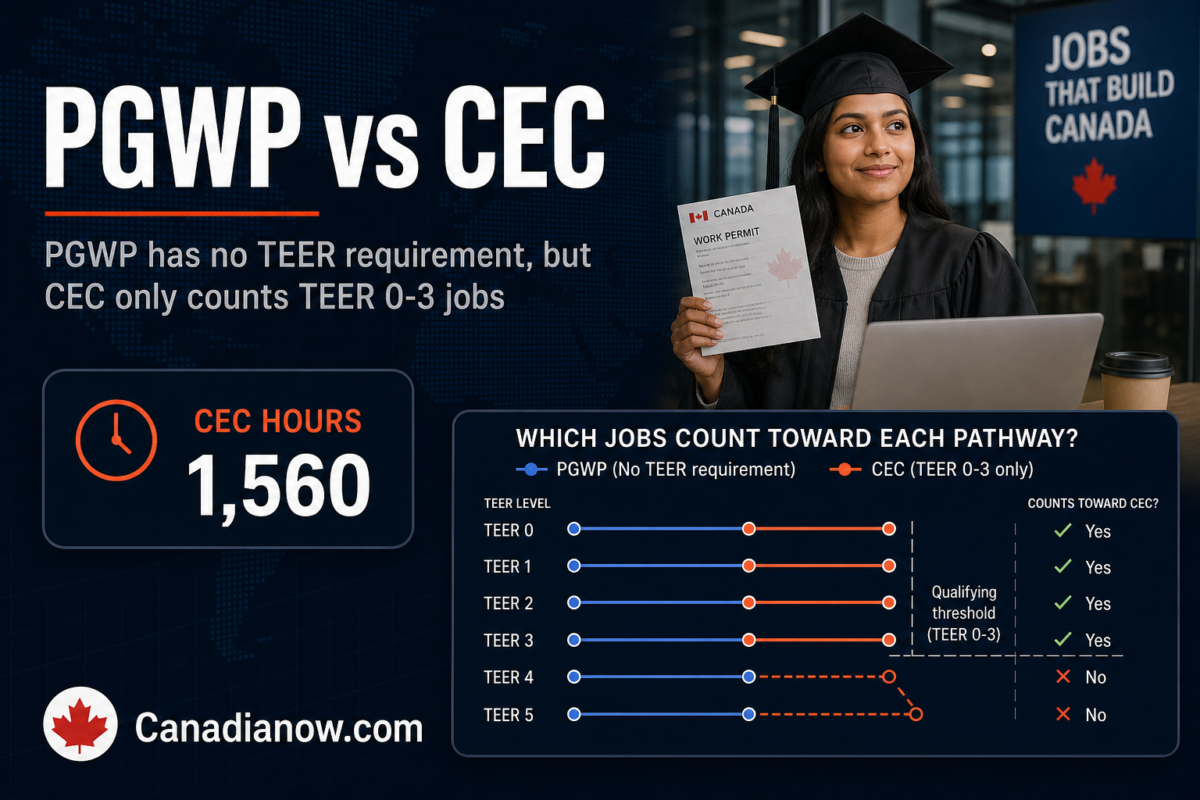
Your PGWP lets you work for any employer, in any job. Many graduates take the first job they can find — a cashier, a server, a warehouse associate, a caregiver — and count the months until they can apply for permanent residence. A year later they discover that none of those hours count toward the Canadian Experience Class. It is one of the most expensive misunderstandings in the student-to-PR journey, and it is completely avoidable.
Quick Answer
The PGWP has no TEER requirement: it is an open work permit, so you can legally work in any job. The Canadian Experience Class does: only paid work in TEER 0, 1, 2 or 3 occupations counts toward the 1,560 hours you need. Hours in TEER 4 or 5 jobs are legal work but do not count for the CEC. If your goal is PR through Express Entry, the job you take in your first months on a PGWP matters as much as having a job at all.
This guide explains general rules. It is not legal advice. Check your occupation’s TEER level against the official NOC before relying on it.
Two Different Rules
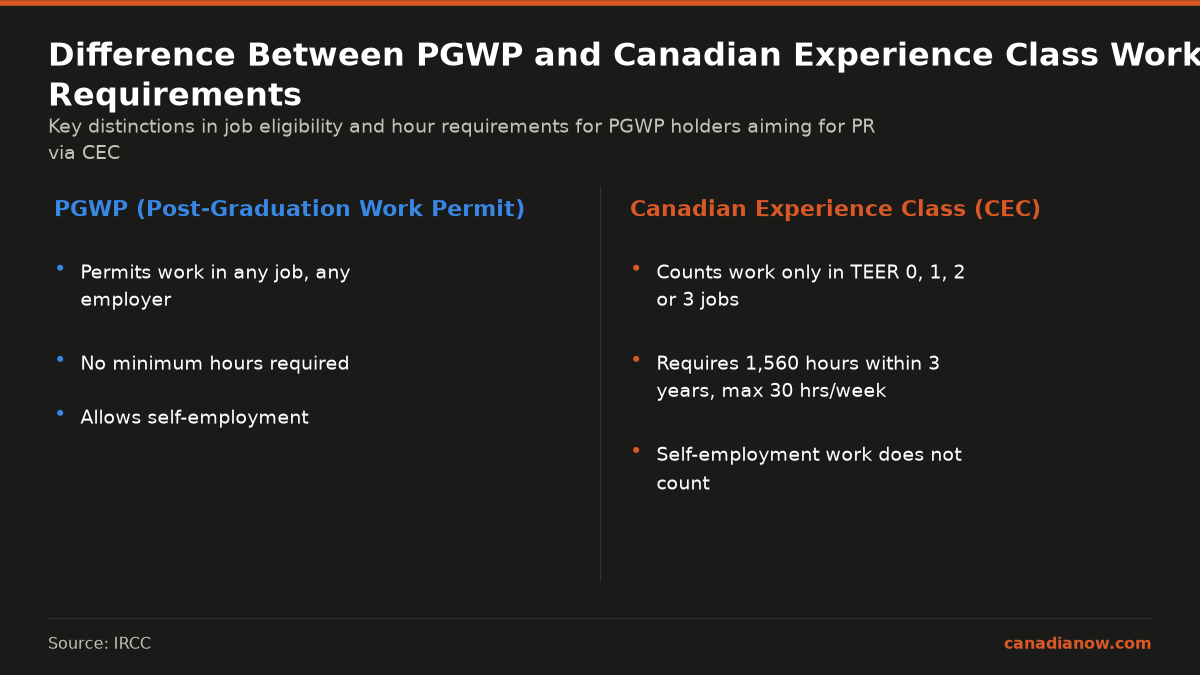
| PGWP | Canadian Experience Class | |
|---|---|---|
| What it controls | Whether you can work | Whether your work counts for PR |
| Job type | Any job, any employer | TEER 0, 1, 2 or 3 only |
| Hours | No minimum | 1,560 hours in 3 years, counted up to 30 hours a week |
| Self-employment | Allowed | Does not count |
Official rule: IRCC’s CEC page requires skilled Canadian work experience in TEER 0, 1, 2 or 3, earned with authorization to work.
Why TEER 4 and 5 Jobs Are So Common on a PGWP
Retail, food service, warehouse and many care jobs are TEER 4 or 5. They are easy to get quickly and often offer the hours students need right after graduation. The problem is not taking them — it is staying in them for the whole PGWP without realizing the clock toward PR is not running.
Watch out for job titles. A “supervisor” or “coordinator” title can be TEER 2 or 3, or it can be a TEER 4 or 5 role with a nicer name. IRCC looks at your actual duties, not your title. Check the lead statement and main duties with the NOC Code Finder.
What to Do in Your First Months on a PGWP
- Look up the TEER of every job you are offered before you accept it.
- If you need income now, a TEER 4 or 5 job is fine — but keep looking for a TEER 0–3 role, and track when you start one.
- Count your qualifying hours with the CEC hours calculator so you know the date you reach 1,560.
- Compare that date with your PGWP expiry. If you will not reach 1,560 hours in time, plan another route early (options by months remaining).
- Consider provincial routes that accept TEER 4 and 5 work — several do (PR routes for TEER 4 and 5 workers).
Other Ways CEC Hours Are Lost
- Self-employment or gig apps such as delivery or ride-share work do not count (gig work and the CEC).
- Work while you were a full-time student, including co-op, does not count — only work after you finish, or while studying part time.
- Hours above 30 a week do not add anything.
FAQ
Is it illegal to work a TEER 5 job on a PGWP?
No. The PGWP is an open work permit. The job simply will not count toward the CEC.
Can TEER 4 or 5 experience help me get PR at all?
Yes, through some provincial nominee streams, the Atlantic Immigration Program and community pilots — just not through the CEC.
Does my PGWP length depend on my job?
No. PGWP length depends on your study program, not on the job you take afterwards.