“What’s your current salary?” is one of the most common — and most uncomfortable — interview questions newcomers face, especially when moving from a country where wages are lower and disclosing them risks anchoring a Canadian offer far below market rate. Whether an employer can legally ask this depends on where in Canada you’re interviewing, and the rules are less uniform, and generally less protective, than many newcomers assume coming from jurisdictions with an outright ban.
Which Provinces Have Banned Salary History Questions (and Which Haven’t)
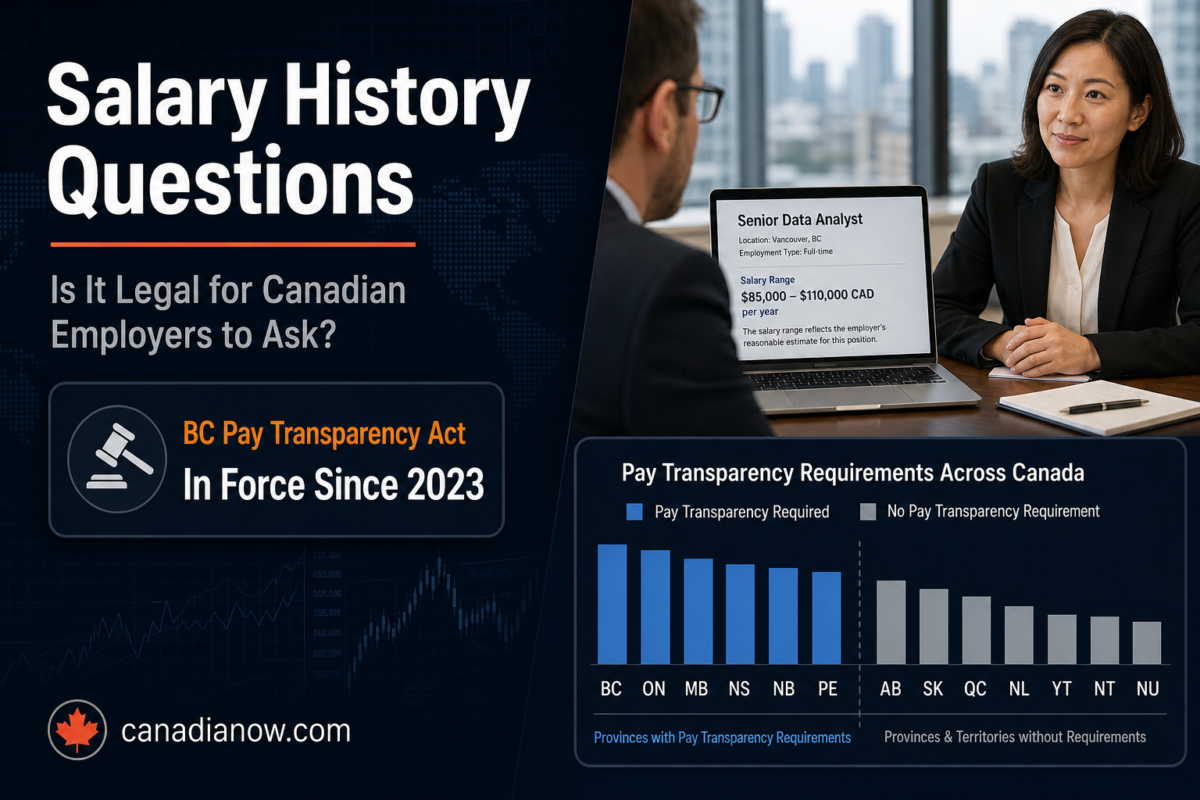
Unlike several US states and cities that have explicitly banned employers from asking about salary history, no Canadian province currently has a direct, blanket ban on the question itself. What Canadian provinces have instead moved toward is pay transparency — requiring employers to disclose a salary range in job postings — which addresses the same underlying problem from a different angle. British Columbia’s Pay Transparency Act (in force since late 2023) requires salary ranges on job postings but does not explicitly prohibit asking about your current salary. Other provinces, including Ontario, have introduced or expanded similar posting-transparency requirements in recent years.
Because this area of law changes fairly often and varies by province, treat any specific claim about what’s “banned” with caution — confirm current rules for your province through the federal Labour Program or your provincial employment standards office before assuming either way.
What You’re Legally Required to Answer vs Not
In virtually every Canadian jurisdiction, you are not legally obligated to answer a salary history question, even in provinces without a specific ban on asking it. Declining to answer, or redirecting toward your salary expectations instead, is not illegal and does not constitute misconduct in an interview. The legal grey area exists entirely on the employer’s side (can they ask), not the candidate’s side (you are never required to answer).
This distinction matters for newcomers specifically: you have exactly the same right to decline as a Canadian-born candidate does, regardless of your immigration status or how new you are to the Canadian job market. Employers cannot make hiring conditional on answering, in the sense that refusing to answer a lawful-but-optional question is not itself a valid reason for rejection they could defend.
Where things do become clearly illegal is if a salary-history question is used as cover for discrimination — for example, if an employer uses your disclosed previous compensation to justify paying you less than a colleague doing the same work for reasons connected to a protected ground like national origin or immigration status. That crosses from “an awkward but legal question” into potential human rights or pay equity violation territory, and is worth raising with your provincial human rights commission or employment standards office if you suspect it’s happening.
How to Redirect the Question During an Interview
The most effective approach used across Canadian hiring — regardless of whether the question is technically restricted in your province — is redirecting to expectations rather than history:
- “I’d rather focus on the value I can bring to this role — based on my research, I’m targeting a range of [X to Y] for a position like this.”
- “My compensation in my previous country doesn’t map cleanly to the Canadian market given cost-of-living and currency differences, so I’ve been benchmarking against Canadian roles instead.”
- “I’m flexible and open to discussing compensation once we’ve confirmed this is the right fit on both sides.”
Before the interview, research using our average salary in Canada and what counts as a good salary guides so your stated range reflects the actual Canadian market rather than a converted figure from your previous country — this is the single most common newcomer mistake in salary negotiation.
Pay Transparency Law Changes by Province
Pay transparency legislation has been actively expanding across Canada, generally requiring salary ranges in public job postings rather than banning the salary-history question directly:
- British Columbia — salary range disclosure required on job postings since November 2023.
- Ontario — pay transparency requirements have been legislated through recent workplace-standards reform, phasing in salary range disclosure on postings.
- Prince Edward Island and Newfoundland and Labrador — have introduced their own pay transparency and pay equity legislation in recent years.
- Other provinces — have not, as of this writing, introduced equivalent salary-range posting requirements; always check your specific province’s current employment standards rather than assuming national uniformity.
Because these rules keep shifting, verify the current requirement in your province directly rather than relying on any single article, including this one, as your final source before an interview.
Sample Responses for Newcomers Uncomfortable Pushing Back
If declining outright feels risky, a softer version still protects you without confrontation: acknowledge the question, then pivot immediately. For example — “That’s a fair question. My previous compensation was structured quite differently given the market I was working in, so I think it’s more useful for both of us if I share what I’m targeting here in Canada instead: [range].” This keeps the interaction collaborative rather than adversarial, which matters especially early in a Canadian job search when you’re still building local references and reputation — the same reputation you’ll want to lean on later if you decide to negotiate a raise or a better offer once you’re established.
Practicing this response out loud before an interview — not just reading it — makes a real difference. Newcomers who rehearse the redirect tend to deliver it calmly and naturally, while those who only plan it mentally often freeze and answer the original question by default when caught off guard.