When a job ends in Canada, your employer issues a Record of Employment (ROE). Block 16 on that form holds a single letter — the reason for issuing — and many people see an “M” or an “E” and assume their EI claim is dead. It is not that simple. The code is your employer’s description of what happened. Service Canada makes its own decision, and you get to tell your side.
Quick Answer
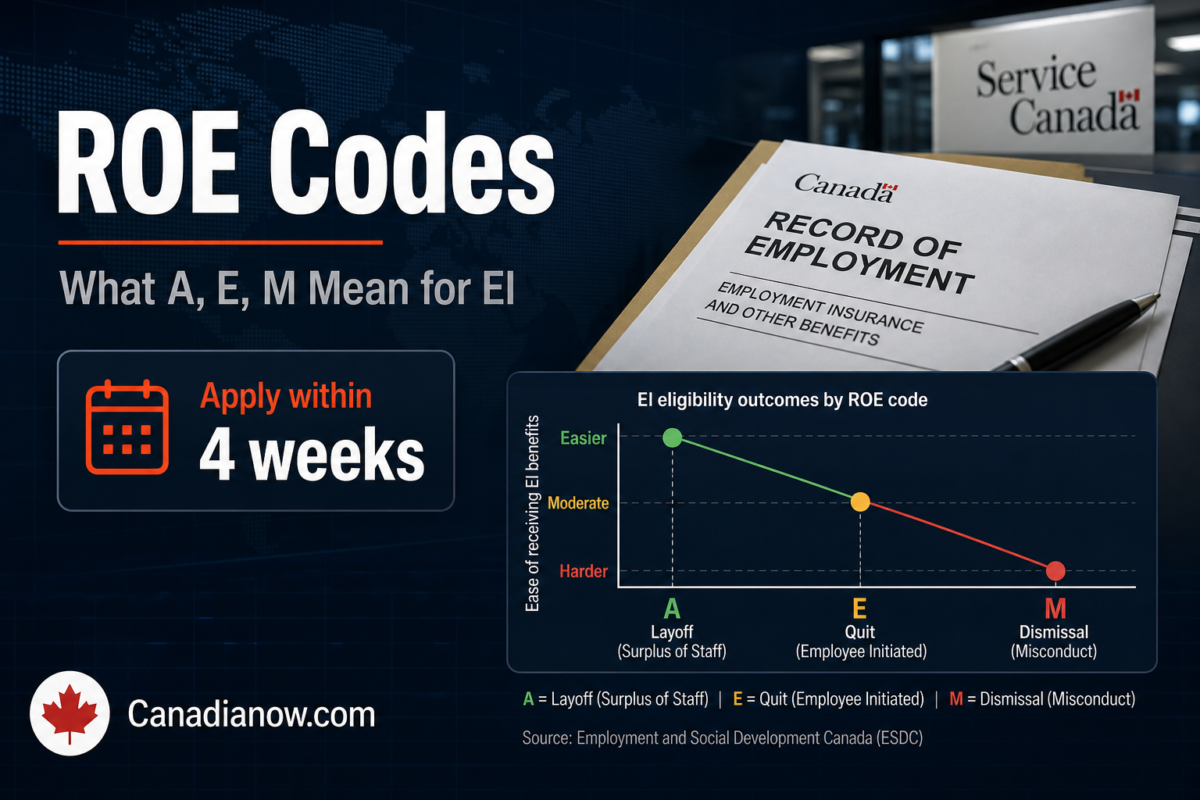
The most common ROE codes are A (shortage of work or end of contract — a layoff), E (quit), and M (dismissal or suspension). Code A usually leads straight to a regular EI assessment. Codes E and M are not automatic refusals: Service Canada asks whether you had just cause for quitting, or whether you were dismissed for misconduct. Codes F, P, D and Z relate to maternity, parental, illness and caregiving benefits. If the code is wrong, you can say so when you apply.
This guide explains general rules. It is not legal advice. EI decisions are made case by case and can be reconsidered and appealed.
ROE Reason Codes (Block 16)
| Code | Meaning | What it usually means for EI |
|---|---|---|
| A | Shortage of work, end of contract or season (also employer bankruptcy or receivership) | The typical layoff code. Regular benefits are assessed on hours and availability. |
| B | Strike or lockout | Benefits are generally not paid during a labour dispute. |
| D | Illness or injury | Points to EI sickness benefits. |
| E | Quit (to follow a spouse, return to school, for health reasons, retirement, another job, employer relocation, to care for a dependant, to become self-employed) | Service Canada checks whether you had just cause and no reasonable alternative to leaving. |
| F | Maternity | Maternity benefits. |
| G | Mandatory retirement, or retirement under an approved workforce reduction | Assessed on the circumstances. |
| H | Work-Sharing | Linked to an approved Work-Sharing agreement. |
| J | Apprentice training | Apprentices in technical training may qualify. |
| K | Other (change of payroll frequency or ownership, requested by EI, at the employee’s request, change of service provider) | Often administrative, not a job loss. |
| M | Dismissal or suspension | Service Canada checks whether the dismissal was for misconduct. Dismissal without misconduct — including many firings during probation — does not by itself disqualify you. |
| N | Leave of absence | Depends on the type of leave. |
| P | Parental | Parental benefits. |
| Z | Compassionate care or family caregiver | Caregiving benefits. |
Code E: When Quitting Can Still Qualify
Official principle: a person who voluntarily leaves a job is disqualified from regular benefits unless they had just cause — meaning that, considering all the circumstances, leaving was the only reasonable alternative.
What it means in practice: situations that may amount to just cause include harassment, dangerous working conditions, significant unilateral changes to your wages or duties, not being paid, or having to follow a spouse who moved. Keep evidence and explain what you tried before leaving (raising it with the employer, filing a complaint).
For work permit holders: if an LMIA employer cut your pay or hours far below what your contract promised, that is relevant — see when an employer cuts hours on an LMIA permit.
Code M: Dismissal Is Not the Same as Misconduct
EI can be refused for dismissal due to misconduct — deliberate or reckless behaviour the employee knew could lead to dismissal. Being let go because the job “wasn’t working out,” for poor performance or during probation is usually not misconduct. Tell Service Canada what happened in your own words (fired during probation).
If the Code Is Wrong or the ROE Is Late
- Wrong code: apply for EI anyway and explain the real reason. Service Canada contacts both you and the employer. Bring documents (layoff notice, emails).
- ROE not issued: employers must issue ROEs within set deadlines (for electronic ROEs, 5 calendar days after the end of the pay period in which your earnings stopped). Apply for EI without waiting — Service Canada can follow up with the employer.
- Find your ROE: electronic ROEs appear in your My Service Canada Account.
Next Steps After Reading Your ROE
- Apply for EI within four weeks of your last day of work.
- Check the hours on the ROE against your pay stubs — insurable hours decide eligibility and benefit length.
- On a work permit, read EI eligibility by permit type.
FAQ
Can I get EI with code E?
Possibly, if Service Canada accepts that you had just cause for leaving and no reasonable alternative.
Can I get EI with code M?
Yes, unless Service Canada finds the dismissal was for misconduct.
My employer won’t give me an ROE. What do I do?
Apply for EI anyway and tell Service Canada. It can contact the employer, and employers who do not issue ROEs on time can face penalties.