You hold a work permit that names one employer, and that employer has just let you go. The first question is almost always “Do I have to leave Canada?” Usually not right away. But an employer-specific permit makes every next step — money, EI, a new job, your PR plans — depend on doing things in the right order. This is the 30-day plan.
Quick Answer
Losing your job does not cancel your work permit or your status — you can stay in Canada until your permit’s expiry date. What you cannot do is work for anyone else until you have a new permit, or IRCC’s email authorization to start a new job while that permit is processed. Get your final pay and Record of Employment, apply for EI within four weeks (but expect questions about your availability on a closed permit), find an employer willing to support a new permit, and, if your employer mistreated you, look at the open work permit for vulnerable workers. If your PR application is in process, check whether a bridging open work permit fits.
This guide explains general rules. It is not legal advice. Termination pay rules are provincial and immigration options depend on your permit and PR stage. For anything disputed, contact your province’s employment standards office or a licensed RCIC.
Days 1–3: Secure Your Pay and Paperwork
- Get the termination in writing, with the last day worked and the reason (layoff, shortage of work, dismissal).
- Final pay: wages owed, unpaid vacation pay, and termination pay or notice if your province’s employment standards require it. Most provinces require notice or pay in lieu once you have worked about three months; the amount grows with service (probation and notice rules).
- Ask for your Record of Employment (ROE). Employers must issue it within days of your last pay period. Check the reason code — it affects EI (ROE codes explained).
- Keep your pay stubs and contract. If you were on an LMIA, your contract shows the wage and hours your employer promised.
Week 1: Understand Your Status
Official rule: IRCC says that if you are laid off, you need a new job offer and must apply for a new permit while remaining in Canada; you cannot work for any employer until the new permit is approved, or you must leave by the “must leave by” date on your current permit.
What it means: you remain a temporary resident until your permit expires. Your permit does not end on your last working day. But the permit only allows work for the employer named on it, so any new job needs new authorization first.
Weeks 1–4: Apply for EI (and Know the Catch)
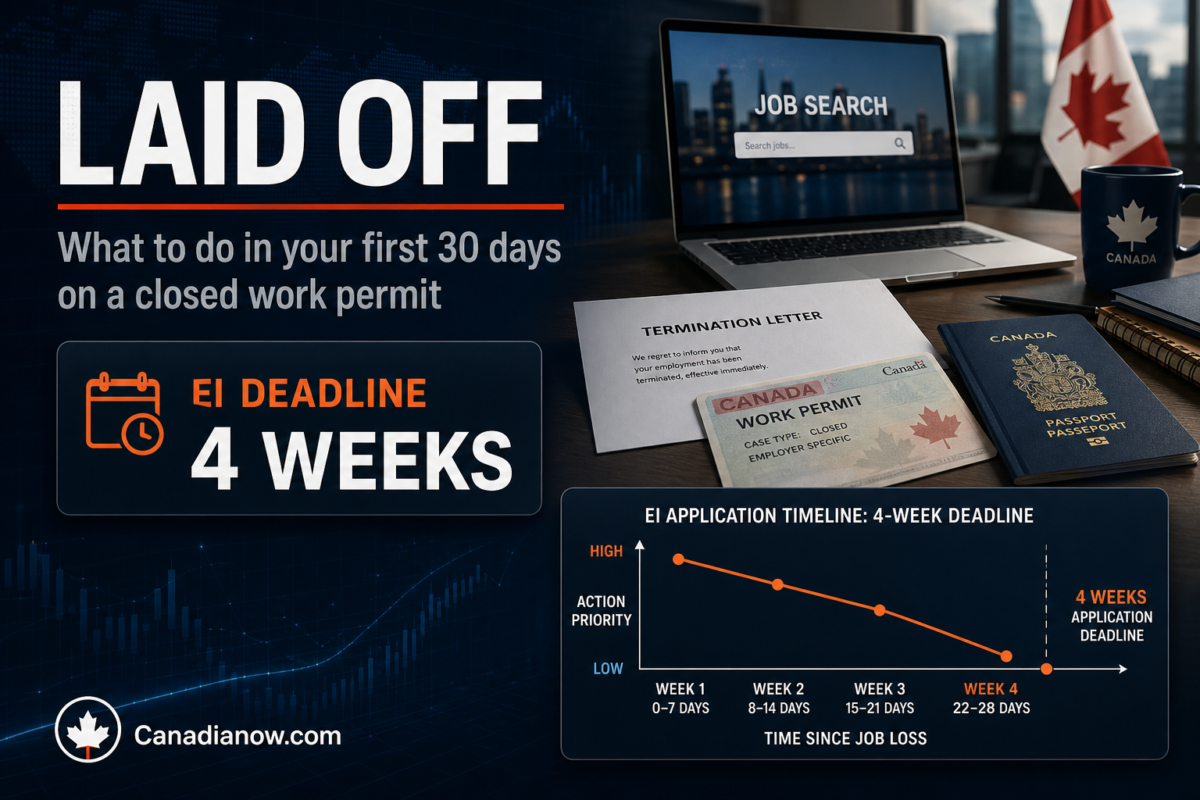
- Apply as soon as possible — Service Canada warns that waiting more than four weeks after your last day of work can cost you benefits.
- You need enough insurable hours — between 420 and 700 in the last 52 weeks for regular benefits, depending on your region’s unemployment rate.
- The closed-permit problem: Service Canada’s guidance says a worker whose permit restricts them to one employer “is not normally considered to be available” for work — but that this is not the only factor. Show that you are actively job-hunting and that you would apply for a new permit as soon as you have an offer. We explain the test in detail in EI for work permit holders.
Weeks 1–4: Find Your Next Permit
| Route | When it fits |
|---|---|
| New employer-specific permit (LMIA or LMIA-exempt) | A new employer supports you; LMIA jobs need the employer’s approved LMIA first |
| Authorization to start the new job early | After you apply for the new employer-specific permit, request it by IRCC web form with priority code PPCHANGEWORK2020; IRCC says it responds in about 10–15 days (how it works) |
| Bridging open work permit | Your PR application has passed IRCC’s completeness check (BOWP guide) |
| Open work permit for vulnerable workers | Your employer abused you or put you at risk of abuse (evidence guide) |
| Spousal open work permit | Your spouse’s job or study program qualifies |
| Visitor record | You need time in Canada without working |
If You Were Relying on This Job for PR
- Provincial nominee: report the job loss to the province now — some give you a fixed period to find a new job (each PNP’s rules).
- AIP or community pilot: your endorsement is tied to the job (AIP rules).
- Express Entry: job loss after you apply usually does not sink the file, but report it (details).
- Still building CEC hours: the gap pauses your count; hours you already worked still count if they are within 3 years (check your hours).
Day 30 Checklist
- Final pay, vacation pay and any termination pay received — or a complaint filed with employment standards
- ROE issued and EI application submitted
- New job offer or permit route identified; application filed before your permit expires
- Province or IRCC told about the change if your PR depends on it
- Health coverage and SIN still valid until your permit’s expiry — note that date (Status Expiry Timeline)
FAQ
Do I have to leave Canada when I’m laid off?
No. You can stay until your permit expires, but you cannot work for another employer without new authorization.
Can I work for a new employer while my new permit is processed?
Only after you apply for the new employer-specific permit and receive IRCC’s email authorization (priority code PPCHANGEWORK2020). The email is not a permit, but it lets you start.
Can I get EI on a closed work permit?
Possibly. Service Canada looks at your availability. A permit restricted to one employer counts against you, but it is not decisive if you show you are actively seeking work and would get a new permit for an offer.