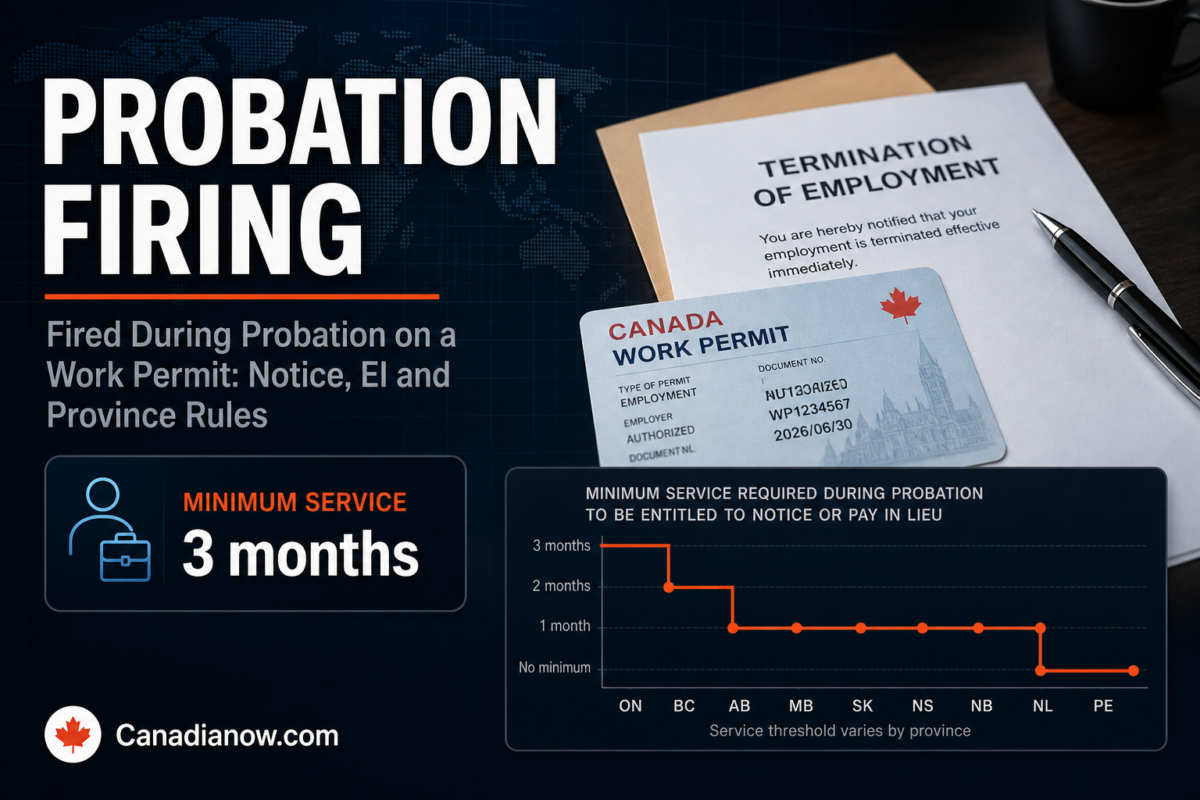
Many newcomers are let go in their first weeks at a new job with the words “it’s still your probation period.” Some employers treat probation as a period where anything goes. Legally, it is narrower than that — and on a work permit, being let go has consequences beyond losing a paycheque.
Quick Answer
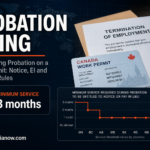
“Probation” is mostly a contract term; employment standards laws instead set a minimum length of service before notice or termination pay is owed — usually around three months (Ontario, BC, Nova Scotia, Newfoundland and Labrador, Quebec), 90 days in Alberta, 13 weeks in Saskatchewan, 30 days in Manitoba and six months in New Brunswick. Before that point, you can generally be let go without notice — but you are still owed all wages and vacation pay, and firing you for a discriminatory or retaliatory reason is illegal at any time. Being dismissed during probation is not usually “misconduct” for EI. On a closed work permit, you then need a new permit to work elsewhere.
This guide explains general rules. It is not legal advice. Your contract, collective agreement or common-law rights may give you more than the minimums below. Contact your province’s employment standards office for your situation.
Minimum Service Before Notice Is Owed
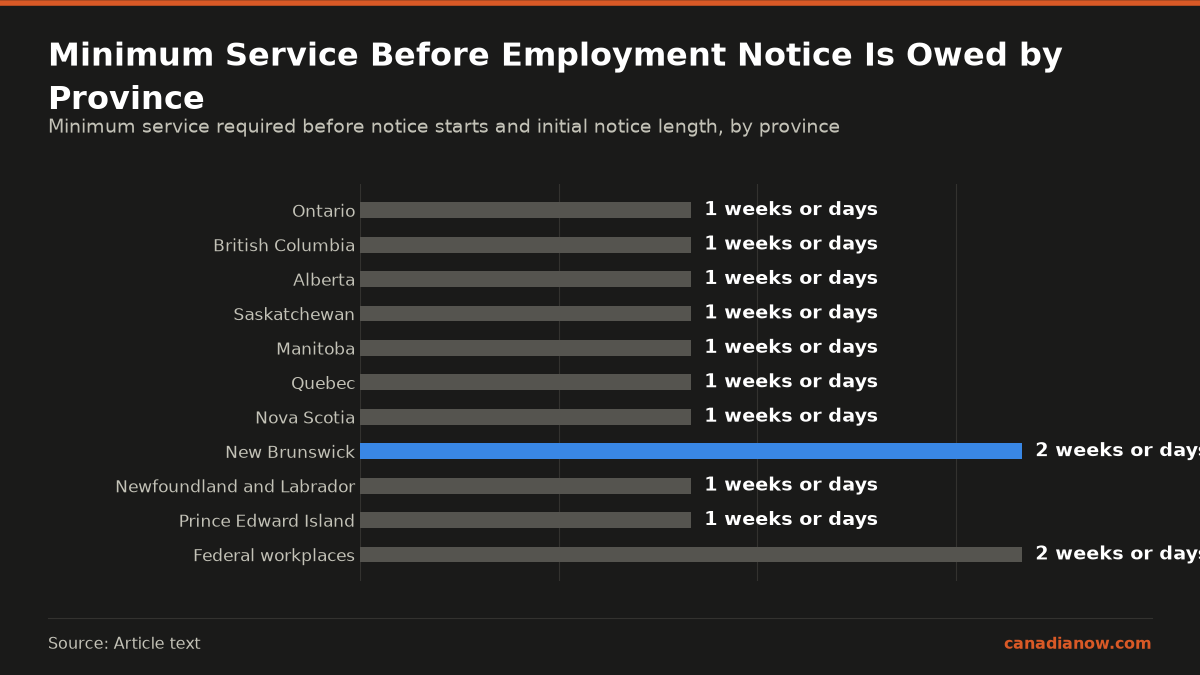
| Jurisdiction | Notice starts after | First level of notice |
|---|---|---|
| Ontario | 3 months | 1 week (3 months to 1 year) |
| British Columbia | 3 consecutive months | 1 week |
| Alberta | 90 days | 1 week (90 days to 2 years) |
| Saskatchewan | 13 consecutive weeks | 1 week |
| Manitoba | 30 days | 1 week (under 1 year) |
| Quebec | 3 months of uninterrupted service | 1 week |
| Nova Scotia | 3 months | 1 week |
| New Brunswick | 6 months | 2 weeks |
| Newfoundland and Labrador | 3 months | 1 week |
| Prince Edward Island | Recently amended — check current rules (reported to be 90 days) | 1 week |
| Federal workplaces (banks, airlines, telecom, trucking across borders) | 3 consecutive months | 2 weeks |
Notice can be given as advance written notice or as pay in lieu. Longer service increases the notice — up to eight weeks in most provinces.
What You Are Owed No Matter What
- All wages for hours worked, including any overtime
- Vacation pay earned (usually at least 4% of wages) — vacation pay when a job ends
- Public holiday pay you qualified for
- A Record of Employment (ROE codes explained)
When a Probation Firing Is Still Illegal
Human rights laws apply from the first day. Letting someone go because of race, national or ethnic origin, sex, pregnancy, disability, religion or another protected ground is discrimination. Firing someone for asking about their employment standards rights, or for complaining about unsafe work, is a reprisal. These can be challenged regardless of how long you worked.
EI After a Probation Dismissal
Your ROE will usually say M (dismissal). Service Canada refuses regular benefits only for misconduct — deliberate or reckless behaviour — not for simply not being the right fit. You will also need enough insurable hours, which is often the harder part after a short job. On a closed permit, Service Canada will also look at your availability (EI for work permit holders).
Your Work Permit
- Open permit or PGWP: you can start looking and working elsewhere immediately.
- Closed permit: your status continues until expiry, but you need a new permit to work for another employer (first 30 days after losing a closed-permit job).
- LMIA job: if the employer hired you through an LMIA and let you go quickly, ESDC may want to know whether the job was genuine — you can report confidentially.
FAQ
Can I be fired without any reason during probation?
Generally yes before the minimum service period, as long as the reason is not discriminatory or retaliatory. You are still owed wages and vacation pay.
My contract says probation is 6 months. Does that override the law?
No. A contract cannot give you less than the employment standards minimum. In Ontario, for example, notice is owed after 3 months even if the contract says probation is longer.
Can I get EI if I was fired during probation?
Possibly, if it was not for misconduct and you have enough insurable hours.