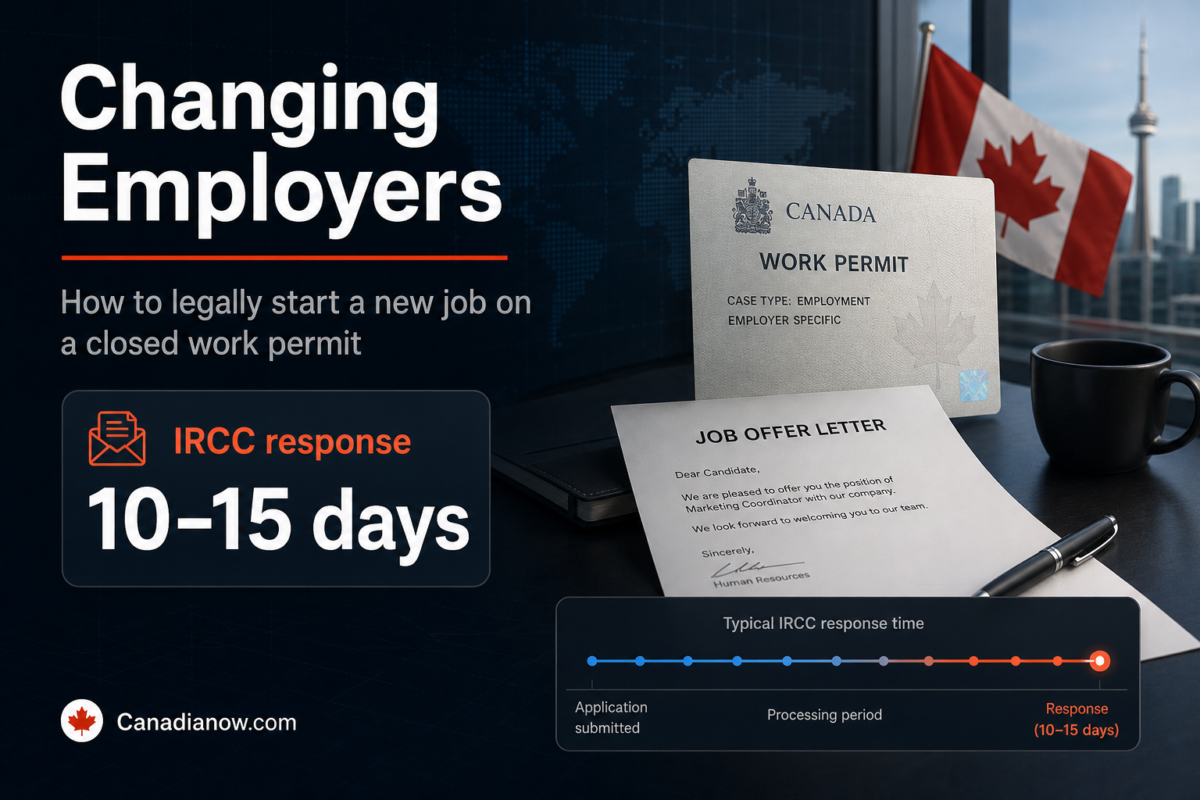
You have a better job offer. The problem: your work permit has your current employer’s name on it. Can you accept, and when can you actually start? For years the answer was “not until the new permit arrives,” which could mean months without pay. IRCC now has a faster route — but it only works if you do things in the right order.
Quick Answer
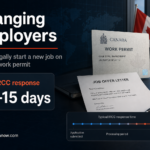
Yes, you can change employers on an employer-specific (closed) work permit, but you need a new work permit for the new job. The new employer usually needs an approved LMIA (or an LMIA-exempt offer through the IRCC Employer Portal). After you apply for the new permit from inside Canada, you can ask IRCC — through its web form with priority code PPCHANGEWORK2020 — for authorization to start the new job before the permit is approved. IRCC says it responds in about 10 to 15 days. Until you have that email or the new permit, keep working only for your current employer.
This guide explains general rules. It is not legal advice. If your PR application or provincial nomination depends on your current job, check the consequences before resigning.
Step by Step
- Get the new offer in the right form. An LMIA-based job needs the new employer’s positive LMIA. For an LMIA-exempt job, the employer submits the offer through the IRCC Employer Portal and pays the compliance fee, and gives you the offer number.
- Do not resign yet if you can avoid it — your current job is still your only authorized work.
- Apply online for the new employer-specific work permit from inside Canada.
- Request authorization to start working: submit IRCC’s web form with the priority code PPCHANGEWORK2020, your application number, the new employer’s name, your start date and the NOC code.
- Wait for IRCC’s email (about 10–15 days for online applications; longer on paper). IRCC notes the email is not your work permit, but it lets you start the new job.
- Give notice to your current employer and start the new job on or after the authorized date.
- When the new permit arrives, update your SIN record and health card.
Who Can Use the Early-Start Authorization
Official rule: IRCC says you may be able to start your new job before the permit is approved if you applied for a new employer-specific work permit in Canada and you currently hold an employer-specific permit, or are working without a permit under certain exemptions (business visitors and short-term Global Skills Strategy workers excluded).
What it means: the request comes after your new permit application, not instead of it. Without a submitted application, IRCC has nothing to attach the authorization to.
If Your Permit Is About to Expire
Apply for the new permit before your current one expires. You then have maintained status under your current conditions — meaning you can keep working for your current employer, not the new one — until IRCC issues the early-start authorization or the new permit (maintained status explained).
If You Were Laid Off or Left an Abusive Job
- Laid off: you can still use this route once you have a new offer — see your first 30 days after a layoff.
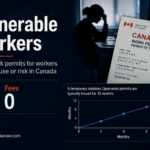
- Abuse or mistreatment: the open work permit for vulnerable workers lets you work for almost any employer without a new LMIA.
Check These Before You Switch
- Provincial nominees: most PNPs want to approve a job change first (PNP rules).
- AIP candidates: you need an updated endorsement and IMM 0157 within IRCC’s 90-day deadline (AIP rules).
- Express Entry applicants: changing jobs after applying usually does not harm the file, but report it (details).
- CEC hours: make sure the new job is also TEER 0–3 if you are still building experience (count your hours).
FAQ
Can I work for both employers while waiting?
Only for your current employer, until IRCC authorizes the new job. After that, you work under the new authorization.
Is the IRCC email a work permit?
No. IRCC says the email is not your work permit, but it authorizes you to start working for the new employer while your application is processed.
Does my new employer need an LMIA?
Usually, unless the job is LMIA-exempt (for example under an international agreement or certain provincial or intra-company categories).