Social work is one of the more approachable regulated professions for internationally trained newcomers — there’s steady demand, a clear licensing path in every province, and unlike some regulated fields, the credential recognition process is relatively well-documented. It’s also one of the professions where “regulated” doesn’t mean “impossible” — it means there’s a defined process, and knowing that process upfront saves years of confusion.
NOC Code and Where Social Work Sits on the In-Demand Occupations List
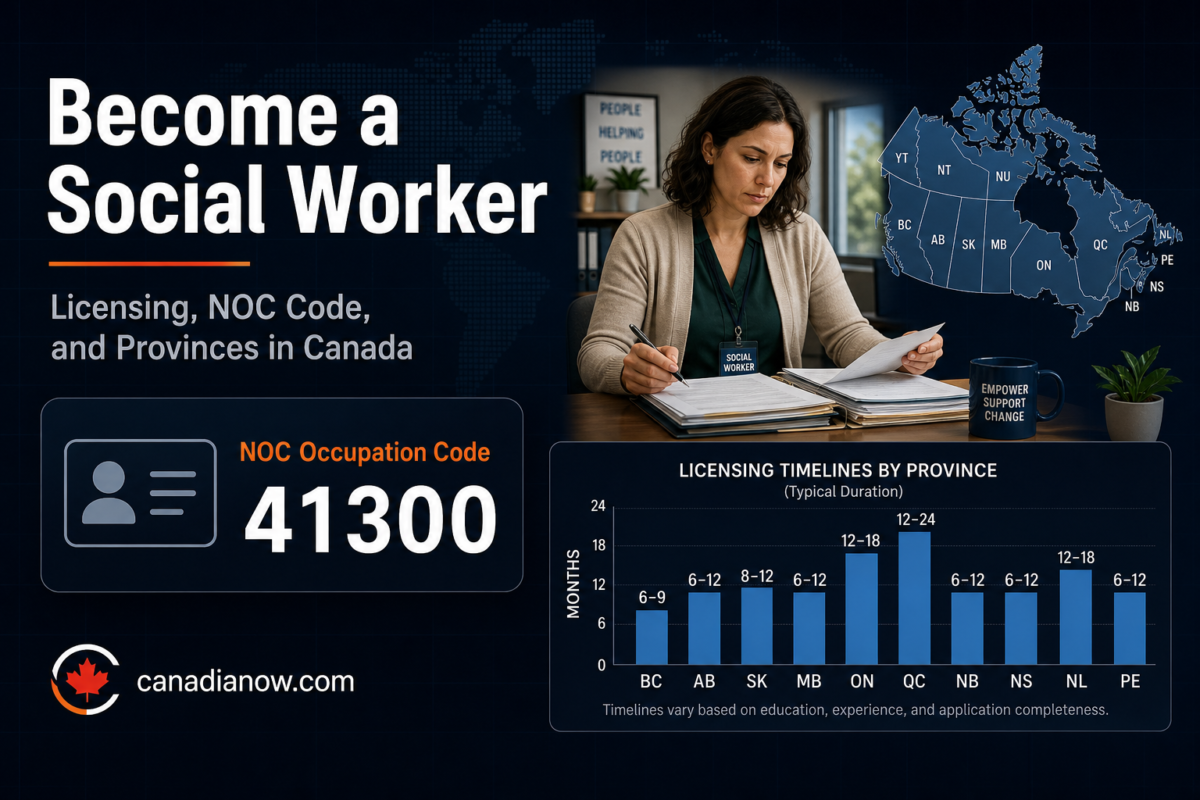
Social workers fall under NOC code 41300 in Canada’s National Occupational Classification system, within the broader category of professional occupations in social and community services. This code matters beyond job listings — it’s also what Express Entry and most Provincial Nominee Programs use to assess whether your foreign work experience qualifies toward immigration points, so getting familiar with it early is useful even before you’re licensed. Recent NOC code updates are worth checking periodically, since classification changes can affect how your experience is assessed.
Social work consistently appears on provincial in-demand and priority occupation lists, particularly in child welfare, mental health, and healthcare-adjacent roles, though demand and program eligibility shift periodically — always confirm current status through the relevant provincial program before assuming eligibility.
Provincial Licensing Bodies — Why Requirements Differ by Province
Unlike some professions regulated federally, social work licensing in Canada is entirely provincial. Each province and territory has its own regulatory college or association, and — critically — a license from one province does not automatically transfer to another, though a labour mobility framework exists to streamline this for most regulated professions. Examples of the provincial bodies you’ll deal with include the Ontario College of Social Workers and Social Service Workers, the British Columbia College of Social Workers, and the Alberta College of Social Workers, each with its own application process, fees, and continuing education requirements.
This provincial patchwork is the single biggest source of confusion for internationally trained social workers — the same degree can lead to a faster licensing path in one province and a much slower one in another, depending on how that province’s college evaluates foreign credentials.
A practical tip that saves months of delay: contact the provincial college directly before you land, not after. Most colleges will do a preliminary review of your credentials and outline exactly what’s missing — additional coursework, supervised hours, or a language test — long before you need to submit a full application. Waiting until after arrival to start this conversation is the most common reason internationally trained social workers spend a year or more working outside their field while licensing catches up.
Credential Recognition for Internationally Trained Social Workers
Most provincial colleges require a credential evaluation to confirm your foreign social work degree is equivalent to a Canadian Bachelor of Social Work (BSW) or Master of Social Work (MSW). This typically involves submitting transcripts and course descriptions for assessment, and in many cases, completing bridging courses or supervised practice hours if your education doesn’t fully align with Canadian curriculum requirements. The Canadian Information Centre for International Credentials (CICIC) is the standard starting point for understanding how foreign credentials are assessed across provinces before you approach a specific college.
Separately, if you’re also going through Express Entry, note that an Educational Credential Assessment (ECA) for immigration purposes is not the same evaluation as provincial licensing recognition — you may need both, for different purposes, and completing one does not satisfy the other. Newcomers sometimes assume their immigration ECA covers professional licensing too; it doesn’t.
Average Salary by Province
Social worker salaries vary meaningfully by province, setting, and specialization (child welfare, healthcare, mental health, and private practice all pay differently). As a general pattern:
- Ontario and British Columbia tend to offer the highest overall salary ranges, particularly in hospital and government roles.
- Alberta offers competitive public-sector social work salaries, especially within healthcare and child services.
- Atlantic provinces generally offer lower salary ranges but a correspondingly lower cost of living.
- Unionized government and hospital positions typically pay more than non-profit or community-agency roles, regardless of province.
For current, detailed figures by role, cross-reference our average salary in Canada breakdown, since social work salary bands shift with each round of provincial public-sector wage settlements.
Fastest Path: Which Provinces Recognize Foreign Social Work Degrees
There’s no single “easiest” province for every applicant — it depends heavily on where you trained and how closely your program maps to Canadian curriculum standards. That said, a few practical patterns hold for most internationally trained applicants:
- Provinces with larger, more established credential-assessment infrastructure (Ontario, British Columbia, Alberta) tend to have clearer, faster documented processes, even if the volume of applications means longer queues.
- Smaller provinces sometimes process individual applications faster simply due to lower volume, but may have less experience assessing less-common foreign programs.
- Provinces actively recruiting for social work under provincial nominee streams sometimes offer smoother coordination between the licensing college and the immigration program, since both are trying to solve the same labour shortage.
Most internationally trained social workers should budget 6–18 months from application to full licensure, depending on whether bridging coursework or supervised hours are required. Starting the credential evaluation process as early as possible — ideally before landing, where the province allows it — is the single biggest lever newcomers have over that timeline.