If you have worked in Canada on a work permit, EI premiums have come off every paycheque. So when the job ends, you would expect to be able to claim. Often you can — but EI has a test that citizens rarely think about and that work permit holders run into constantly: you must be available for work. What your permit allows decides whether you pass it.
Quick Answer
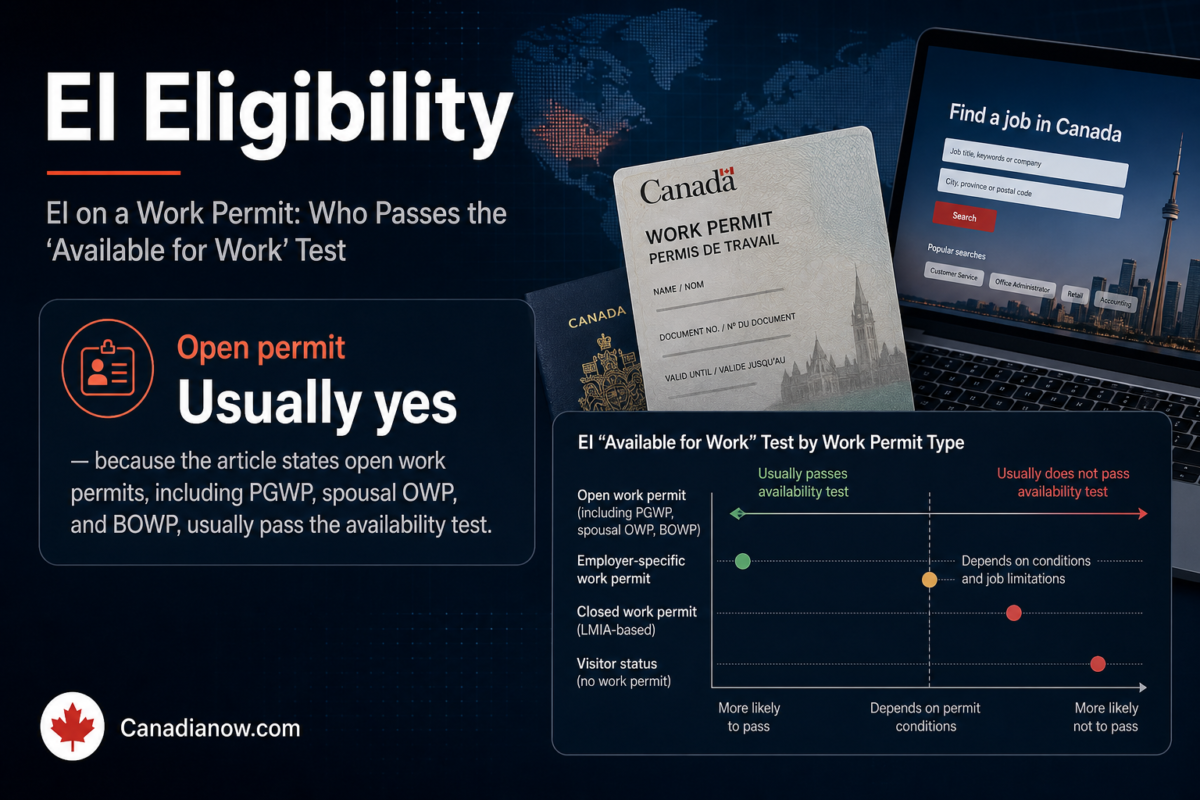
Work permit holders can get EI on the same terms as anyone else: enough insurable hours, a valid reason for job loss, and — for regular benefits — being ready, willing and able to work. An open work permit (including a PGWP, spousal or bridging permit) usually passes the availability test. An employer-specific permit is “not normally considered” available, according to Service Canada’s own guidance, but that is not automatic — it depends on the facts. Maternity, parental and sickness benefits do not have the same availability test, so your permit type matters much less for them. If your status has expired without maintained status, you are not authorized to work and cannot be available.
This guide explains general rules. It is not legal advice. Service Canada decides each claim on its facts, and decisions can be reconsidered and appealed. Keep records of your job search.
The Matrix: EI Regular Benefits by Permit Type
| Your situation | Availability for regular benefits | What helps your claim |
|---|---|---|
| Open work permit (incl. PGWP, spousal OWP, BOWP) | Usually yes — you can work for any employer | Active, documented job search; permit valid for the period claimed |
| Employer-specific permit, job ended | “Not normally considered” available, but decided on all the facts | A declaration of availability, active job search, and showing a new offer would lead to a new permit (e.g. LMIA-supported offers, IRCC’s job-change authorization) |
| Maintained status on an open permit | Usually yes, under the same conditions | Proof you applied before your permit expired |
| Maintained status on a closed permit | Same issue as a closed permit | As above |
| Permit expired, no maintained status (or restoration pending) | No — you are not authorized to work | Restore your status first |
| Study permit holder | Limited — study permits restrict work during classes, and full-time students are generally not considered available | Depends on your schedule and permit conditions |
What Service Canada Actually Says
Official guidance: the Digest of Benefit Entitlement Principles, Chapter 10, says foreign workers can generally only show availability if they hold a work permit that allows them to work. A person whose permit only allows them to work for a specific employer “is not normally considered to be available” — but “the simple fact that the work permit restricts the worker to one employer is not the only factor.” Service Canada is told to gather the facts, get a declaration from the claimant, and consider whether the restriction would be removed once the claimant receives a new job offer.
What it means: on a closed permit, your claim is not automatically refused — but you have to make the case. Two things help: showing you are applying for jobs whose employers can support a permit, and pointing out that IRCC lets employer-specific permit holders get authorization to start a new job while a new permit is processed (how that works).
Special Benefits: Maternity, Parental, Sickness
These benefits are for people who cannot work because of pregnancy, a new child or illness, so the “available for work” test for regular benefits does not apply in the same way. You still need 600 insurable hours in the qualifying period and the other eligibility conditions. For many closed-permit holders, these are the EI benefits most within reach. See maternity and parental leave in Canada.
Hours and Timing
- Regular benefits: 420 to 700 insurable hours in the last 52 weeks, depending on your EI region’s unemployment rate. Service Canada has a postal-code lookup for your region.
- Apply within four weeks of your last day of work.
- Your ROE code matters: quitting or dismissal for misconduct can disqualify you from regular benefits (ROE codes explained).
- Maximum weekly benefit in 2026: $729 (EI and CPP figures).
Your SIN and Permit Expiry
A 9-series SIN expires with your permit. If you are on maintained status, keep your proof of application ready — Service Canada may ask for it (expired SIN on maintained status). Benefits are tied to your authorization to work; plan for what happens if your permit ends during your claim.
How to Strengthen Your Claim
- Keep a job-search log: date, employer, position, how you applied, response.
- Answer the availability questions honestly and specifically.
- If you have an employer-specific permit, explain your plan for a new permit (new LMIA offer, PNP-supported job, BOWP eligibility).
- If refused, ask for reconsideration within 30 days of the decision.
FAQ
I paid EI premiums. Doesn’t that entitle me to benefits?
Premiums are required, but benefits also depend on hours, the reason your job ended and, for regular benefits, availability.
Can I get EI on a PGWP?
Yes, if you meet the usual conditions. A PGWP is an open permit, so availability is rarely the problem.
Does claiming EI hurt my PR application?
Receiving EI you are entitled to is not a problem in itself. Some PR programs look at your employment history, so keep records.