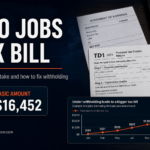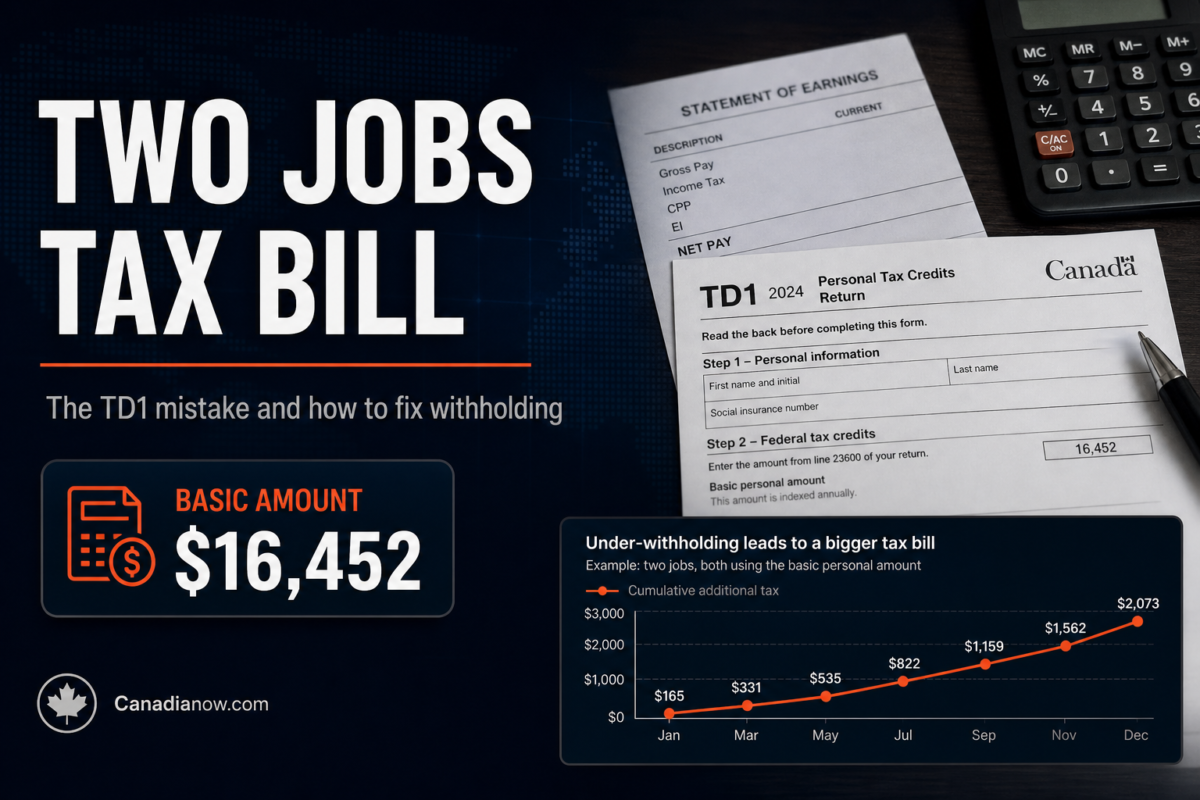
Two part-time jobs are one of the most common ways newcomers make ends meet in their first years — and one of the most common reasons for an unexpected tax bill in April. Nobody did anything illegal. Each employer simply deducted tax as if it were your only job. This page explains why that happens, how to fix it on the TD1 form, and includes a checker to estimate what you might owe.
Quick Answer
Each employer calculates tax as if its pay is your only income, and usually applies the basic personal amount — the income you can earn tax-free — again. With two jobs, that tax-free amount gets counted twice and your combined income is taxed at higher brackets than either employer assumes. The fix: on the TD1 form for your second job, tick that you have more than one employer and enter $0 as your total claim, and if needed ask for additional tax to be deducted each pay. CRA’s rule: you can claim the personal amounts with more than one employer only if your total income from all employers will be less than your total claim amount.
This page explains general rules. It is not tax advice. The checker is an estimate using 2026 rates and the basic personal amount only.
Two-Job Tax Checker
Why Two Jobs Leave You Owing
- The tax-free amount is counted twice. In 2026 the federal basic personal amount is $16,452, plus a provincial amount. If both employers apply it, you were under-taxed on the second job from the first dollar.
- Brackets stack. Your second job’s income sits on top of your first, so it is taxed at your higher marginal rate — but the second employer withholds as if you were in the lowest bracket.
- CPP can come out below the yearly amount. Each employer applies the $3,500 CPP basic exemption, so combined CPP deductions can be lower than the maximum for your income. You are not required to make up the difference, but you can choose to contribute more with Form CPT20. EI can go the other way: if both jobs deduct premiums and your combined pay is above the yearly maximum, the extra is refunded when you file (CPP and EI with two jobs).
How to Fill Out the TD1 for Your Second Job
- Complete the federal TD1 and your province’s TD1 form for the second employer.
- Tick the box saying you have more than one employer or payer at the same time.
- Enter $0 as your total claim amount (unless your combined income from all jobs will be less than your total claim amount).
- If the checker shows you would still owe, request additional tax deductions per pay on the federal TD1.
- Keep the TD1 at your main job as normal.
CRA’s official rule is on the TD1 forms themselves: if you have more than one employer or payer at the same time and you have already claimed personal tax credit amounts on another form, you generally cannot claim them again.
Already Owe Money?
- File on time — by April 30 — even if you cannot pay the full amount, to avoid the late-filing penalty (tax deadlines).
- The CRA offers payment arrangements.
- If you owe more than $3,000 two years in a row (varies in Quebec), the CRA may ask for quarterly instalments. Fixing your TD1 prevents this.
Newcomers: One More Trap
In your arrival year you may also have income from abroad before you moved. It is not taxed in Canada if you were not yet a resident, but it matters for some benefit calculations. See the first-time tax filing guide. To see your take-home pay for a single job, use the salary calculator.
Frequently Asked Questions
Is it illegal to claim the basic personal amount at both jobs?
It is not a crime, but it is incorrect unless your total income will be below the claim amount, and you will owe the difference when you file.
Will I get a refund with two jobs?
Possibly for EI or CPP overpayments, but on income tax most two-job workers owe unless they adjusted their TD1.
Does this apply to a student with two part-time jobs?
Yes. If your combined income is low, you might stay under the tax-free amounts and owe nothing — run the checker.