Quick Answer
Most newcomers must file a Canadian tax return for the year they became a Canadian resident for tax purposes — even if they earned no Canadian income, even if they only lived here for a few months. Filing on time is how you unlock the Canada Groceries and Essentials Benefit (formerly the GST/HST credit), Canada Child Benefit, climate action incentive, and other benefits. The standard deadline is April 30 for the previous tax year. Self-employed filers have until June 15, but any tax owed is still due April 30.
The First Question: Are You a Canadian Resident for Tax Purposes?
The CRA does not use immigration status to decide. They use residential ties:
- Significant ties: a home in Canada, a Canadian spouse or common-law partner, dependants in Canada
- Secondary ties: personal property in Canada (car, furniture), social ties (memberships, religious affiliations), Canadian driver’s licence, Canadian health insurance, Canadian bank accounts
If you have significant ties or strong secondary ties, you are likely a Canadian tax resident from the date you established them. That date matters — income before it is generally not Canadian-taxable; income after it generally is.
| Situation | Likely tax status |
|---|---|
| Arrived with work permit, signed a lease, opened a bank account | Resident from arrival |
| Arrived as student, living in residence, family abroad | Usually resident from arrival (under most student situations) |
| Visiting on tourist visa, no Canadian job or home | Non-resident; usually no return needed |
| Permanent resident landed mid-year | Resident from your landing date |
This guide explains general CRA rules. It is not tax, legal, or financial advice. Tax residency questions, foreign income reporting, and treaty interpretation are complex. Before making decisions that affect your taxes, consider consulting a CPA or licensed Canadian tax professional — particularly in your first filing year.
What You’ll Need to File
- SIN (Social Insurance Number) — you cannot file without one
- Date you became a resident for tax purposes (often your landing date or work permit activation date)
- T4 slips from each Canadian employer (issued by end of February)
- T4A, T4E, T5 slips if you received scholarships, EI, or investment income
- Receipts for tuition (T2202 from your school), childcare, medical expenses, charitable donations
- Foreign income information for the part of the year you were a Canadian resident
- Spouse’s tax information if applicable
How to File: Three Realistic Paths
1. Free CRA-certified online software
Wealthsimple Tax, TurboTax Free, GenuTax, and others are CRA-certified for NETFILE. They walk you through a wizard interface and submit directly to the CRA. Free versions handle the vast majority of newcomer returns. The interface is in English and French.
2. Paid online software
The paid tiers ($20–$50) add help with complex situations: foreign income, rental income, self-employment, multiple T-slips, prior-year amendments. Worth it in your first year.
3. Hire an accountant or CPA
For a typical newcomer first return, an accountant charges $150–$400. Worth considering if you have:
- Significant foreign income or assets ($100,000+ in foreign property triggers a T1135 form)
- Self-employment income
- Rental property abroad
- A tax treaty question (especially US, UK, India, Iran, China, Philippines)
- A complex residency date dispute
Filing Deadlines
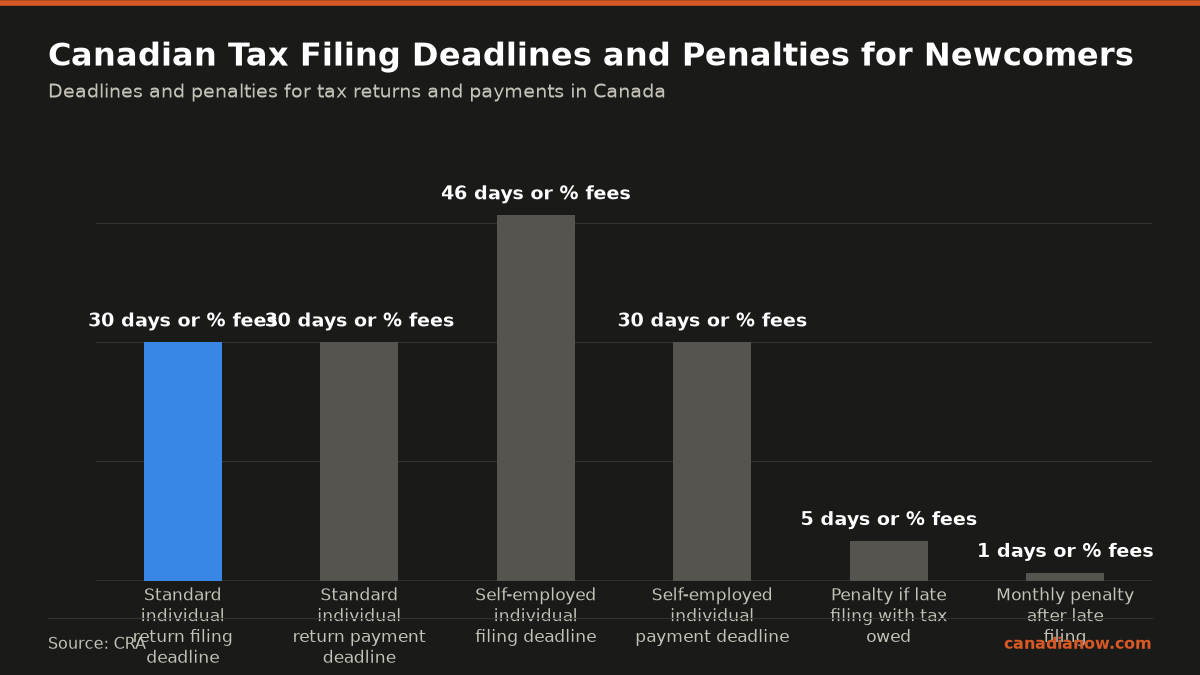
| Situation | Filing deadline | Payment deadline |
|---|---|---|
| Standard individual return | April 30 | April 30 |
| Self-employed individual | June 15 | April 30 (tax owed) |
| Spouse of self-employed | June 15 | April 30 (tax owed) |
| Deceased person’s final return | April 30 or 6 months after death | April 30 or 6 months after death |
If you miss the deadline and owe tax, CRA charges 5% penalty + 1% per month of late filing, plus daily interest. If you are owed a refund, there is no penalty — but you delay getting your benefits.
Why You Should File Even If You Earned Nothing
Many newcomers skip their first return because they earned no Canadian income. This is one of the most expensive mistakes:
- Canada Groceries and Essentials Benefit (formerly GST/HST credit): up to $679 a year for a single person ($890 for a couple) for July 2026 to June 2027. You must file to receive it.
- Canada Child Benefit (CCB): up to ~$7,786 per child under 6 per year. You must file (and your spouse must file) every year to continue receiving it.
- Climate Action Incentive Payment: hundreds of dollars annually depending on your province. File to receive.
- Provincial benefits (Ontario Trillium Benefit, BC climate action tax credit, etc.) usually require a filed federal return.
- Tuition credits carry forward. Even if you cannot use them this year, file to bank them for future years when you have income.
- RRSP contribution room only starts accumulating after you file your first return showing earned income.
Foreign Income in Your First Year
You must report your worldwide income from the date you became a Canadian resident. This often surprises newcomers.
- Income earned before residency date: generally not Canadian-taxable, but you must disclose it on your first return (Box 5365 on the standard return)
- Income earned after residency date: taxable in Canada, even if paid in your home country and never sent to Canada
- Tax treaties with your home country may prevent double taxation — foreign tax credits offset Canadian tax on the same income
- Foreign property over $100,000 CAD (cost): requires form T1135 every year. Penalty for not filing is $25 per day, up to $2,500 (more for repeated offences)
Newcomer Forms and Questions on Your First Return
- Date of entry: the day you became a resident for tax purposes, not necessarily your PR date — how to enter your date of entry.
- Form RC151: sign up for the Canada Groceries and Essentials Benefit (formerly the GST/HST credit) in your first year — CGEB for newcomers.
- Form RC66: apply for the Canada Child Benefit if you have children — CCB for work permit holders.
- Form T1135: not needed in your arrival year, but from the next year if your foreign property costs more than $100,000 — T1135 for newcomers.
- NETFILE rejected? Common for first returns — what to do.
- Two jobs? Expect to owe unless you adjust your TD1 — two jobs and tax.
To see which benefits your status qualifies you for, use the benefits by immigration status checker.
Common Newcomer Mistakes
- Not filing because they did not work in Canada that year (missing benefits)
- Forgetting to enter the date they became a resident (CRA may treat the entire year as resident)
- Not reporting foreign property over $100,000
- Reporting tuition as income (it is not income; it is a tax credit)
- Missing the T2202 from their school
- Filing as single when they have a non-resident spouse abroad (you must declare the spouse and report their world income)
- Using their work permit start date instead of the actual residency date
When to Hire a Tax Professional
For your first Canadian return, consider professional help if any of the following apply:
- Foreign assets over $100,000 (T1135 territory)
- Rental property in your home country
- Self-employment or business income
- A pension or retirement account in your home country
- You arrived mid-year and worked in two countries that year
- You are unsure of your residency date
- You owe a significant amount and need to plan payment
FAQ
I arrived in November and earned no Canadian income that year. Do I still file?
Yes. File to claim the GST/HST credit and Canada Child Benefit. You will likely get money back.
Can I file electronically my first year?
Yes, through NETFILE, as long as the software supports first-year newcomer returns. Most CRA-certified products do.
What if I missed the April 30 deadline this year?
File now anyway. If you are owed a refund, there is no penalty. If you owe tax, the late penalty and interest started accruing on May 1 — the longer you wait, the more it grows.
My SIN starts with 9. Can I still file?
Yes. Temporary residents with 9-series SINs file the standard T1 return.
Sources
- Canada Revenue Agency — Newcomers to Canada (tax information)
- CRA — Determining residency status
- CRA Form T1135 — Foreign Income Verification Statement
- CRA NETFILE-certified software list
Written by Caglar Aybas. Reviewed for accuracy and currency. Last reviewed: May 2026.
Want to know exactly where you stand? Our personalized report covers your CRS score, the PNP and Express Entry categories you actually qualify for, and a realistic next-step plan.