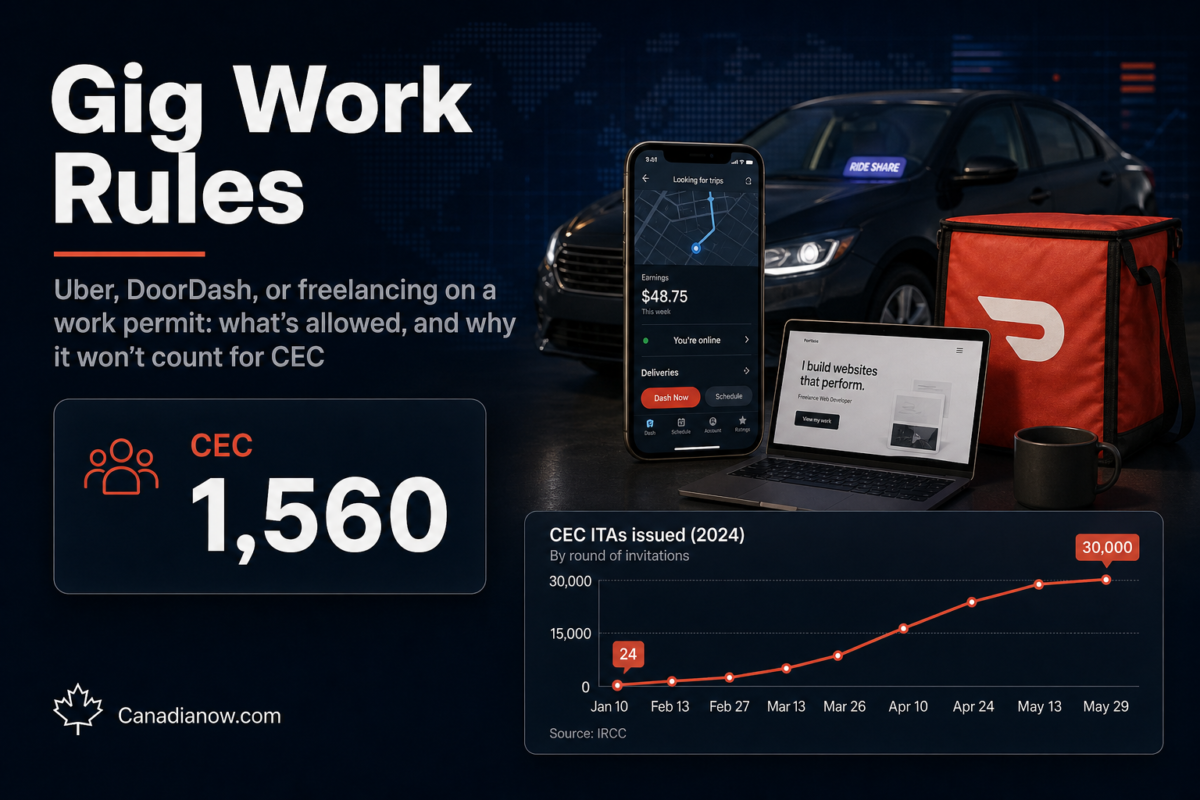
Delivery apps, ride-sharing and freelancing are the fastest way for many newcomers to earn money: sign up, start this week, choose your hours. But on a temporary permit, three separate systems have a say — immigration (are you allowed to do it?), Express Entry (does it count toward PR?) and the CRA (what do you owe?). The answers are different for each.
Quick Answer
On an employer-specific (closed) permit, gig work for anyone other than your named employer is not allowed. On an open work permit or PGWP, you are not tied to an employer, so gig and freelance work is generally possible — but check the conditions printed on your permit. For international students it is less clear-cut: IRCC’s guidance speaks of working for employers within the 24-hour weekly limit, so confirm with your school’s international office before relying on gig income. Whatever your permit, self-employment does not count toward the Canadian Experience Class. And the CRA treats gig workers as self-employed: you pay both halves of CPP, and ride-share drivers must register for GST/HST from their first dollar.
This guide explains general rules. It is not legal or tax advice. Work conditions on your permit override general rules; read them, and ask IRCC or a licensed RCIC if you are unsure.
1. Immigration: Are You Allowed?
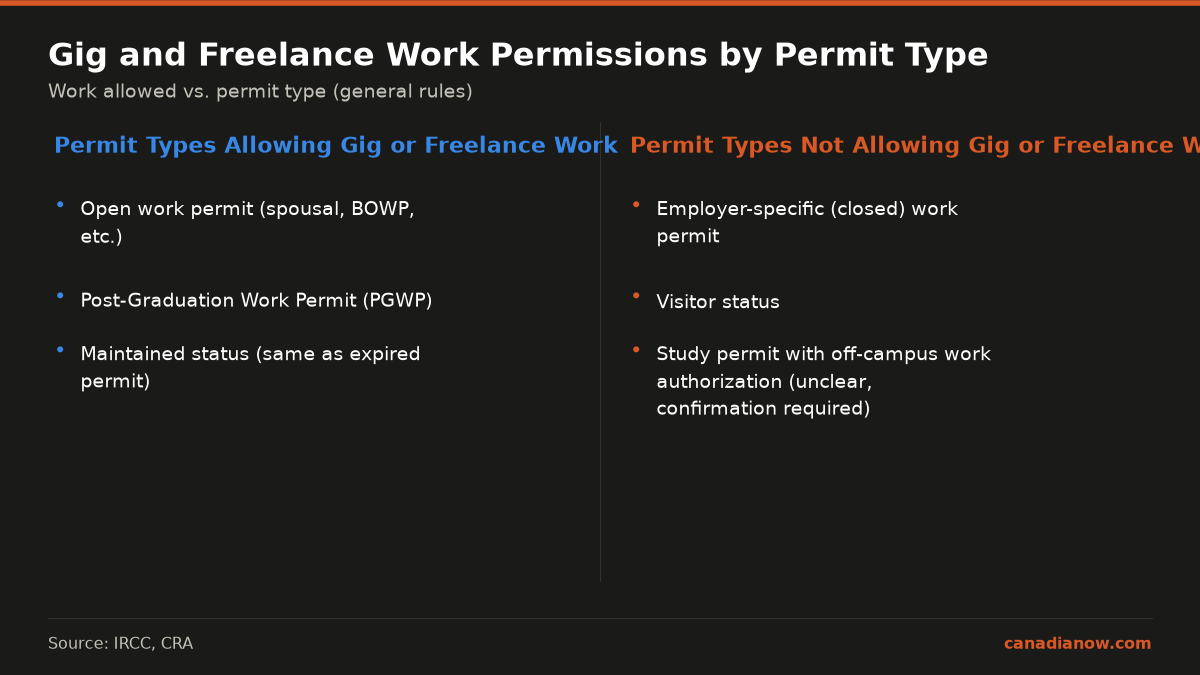
| Your permit | Gig or freelance work |
|---|---|
| Employer-specific (LMIA or LMIA-exempt, closed) | No — you may only work for the employer, job and location on your permit |
| Open work permit (spousal, BOWP, etc.) | Generally possible — the permit is not tied to an employer. Check for conditions on the permit. |
| PGWP | Generally possible — it is an open work permit |
| Study permit with off-campus work authorization | Unclear for self-employment; IRCC’s guidance refers to working for employers, within 24 hours a week during classes. Confirm before starting. |
| Maintained status | Same conditions as your expired permit |
| Visitor status | No — visitors cannot work |
Interpretation: app companies do not check your immigration conditions the way IRCC does. Being able to sign up is not proof you are allowed to work. Unauthorized work can lead to refusal of future applications.
2. PR: Does It Count?
Official rule: IRCC’s Canadian Experience Class page says self-employment does not count toward the required work experience. The same applies to the Federal Skilled Worker program’s Canadian experience points.
What it means: hours spent delivering food or driving for an app — where you are an independent contractor — do not build the 1,560 hours you need. If PR through the CEC is your goal, gig work can supplement income but should not replace a TEER 0–3 job (why job type matters on a PGWP, count your qualifying hours).
Some provincial programs look at self-employment differently, but most worker streams need an employer job offer.
3. Taxes: What You Owe
- You are self-employed for tax purposes. Report your gig income and expenses on Form T2125 with your tax return.
- CPP: self-employed people pay both the employee and employer shares on net self-employment income (CPP and taxes for freelancers).
- No tax is withheld by the apps. Set money aside — many newcomers are surprised by a bill in April.
- GST/HST — ride-sharing: commercial ride-sharing drivers must register for GST/HST as soon as they start, regardless of how little they earn. The $30,000 small-supplier threshold does not apply.
- GST/HST — delivery and freelancing: you must register once your taxable revenue passes $30,000 over four consecutive calendar quarters; you may register earlier voluntarily (GST/HST for self-employed newcomers).
- No EI for self-employed income unless you opt into EI special benefits.
Common Mistakes
- Driving or delivering on a closed permit “just on weekends”
- Counting gig hours toward the CEC
- Not registering for GST/HST as a ride-share driver
- Students exceeding 24 hours a week during classes by combining a job and gig work
FAQ
Can I drive for Uber on a PGWP?
A PGWP is an open permit, so generally yes, subject to any conditions on it. You must register for GST/HST from the start, and the hours will not count for the CEC.
Can I do DoorDash on a closed work permit?
No. An employer-specific permit only allows work for the named employer.
Does freelancing count as Canadian work experience for Express Entry?
Not for the CEC — IRCC excludes self-employment.