Quick Answer
International students in Canada with a valid study permit can work up to 24 hours per week off-campus during regular academic sessions, and full-time during scheduled breaks. The 24-hour cap replaced the old 20-hour rule and remains the standard as of May 2026. Working over the limit is a violation of your study permit conditions and can affect future applications including your PGWP.
Eligibility Snapshot
To work off-campus you must:
- Hold a valid study permit that authorizes off-campus work
- Be enrolled full-time at a Designated Learning Institution (DLI)
- Be in a program leading to a degree, diploma, or certificate of 6 months or longer
- Have a Social Insurance Number (SIN)
- Not start working before your study program begins
Safety first: Working beyond the authorized hours — even by accident, even at a second job — is a violation of your study permit conditions. It can affect your PGWP eligibility, future work permits, and permanent residency applications. Track your weekly hours yourself; do not rely on an employer to do it. If you are unsure whether a specific job arrangement counts, consult a licensed RCIC before accepting the role.
The 24-Hour Rule, Explained
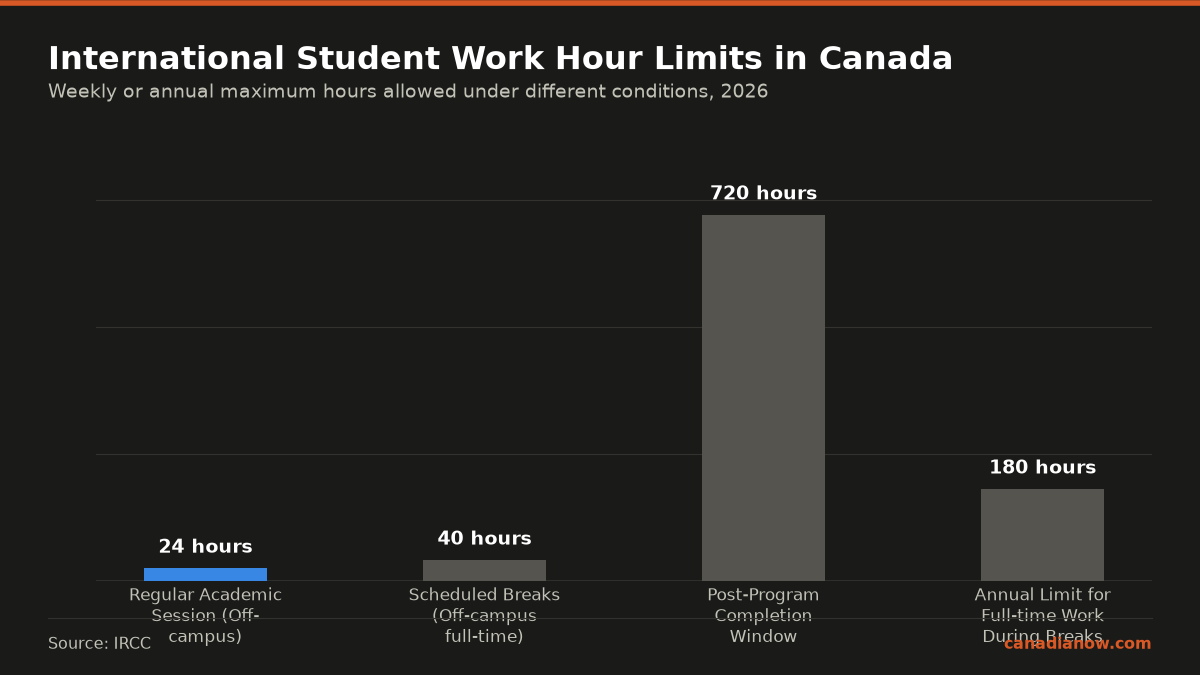
The 24-hour weekly off-campus cap applies during scheduled academic sessions — while classes are running. It is not a daily cap, it is not a per-employer cap, and it cannot be averaged across weeks. If you work 28 hours one week and 20 the next, you have violated the rule in week one regardless of the average.
Two specific scenarios change the cap:
- Scheduled breaks (winter holidays, summer between school years, reading week): you can work full-time during scheduled breaks if you continue to meet eligibility conditions and were a full-time student before and after the break. There is a 180-day per calendar year limit on full-time off-campus work during breaks.
- Program completion: once you receive written confirmation that you have completed your program, you can work unlimited hours until either your study permit’s printed expiry date or 90 days after completion — whichever comes first.
What Changed on April 1, 2026: Co-op Work Permit Removal
Effective April 1, 2026, post-secondary international students no longer need a separate co-op work permit for required student work placements. If your program requires a placement and it represents 50% or less of your total program hours, your study permit alone authorizes the placement. There is no application and no fee.
Practical effects:
- Secondary school students still need the old co-op work permit under the previous rules
- If you previously applied for a post-secondary co-op work permit, you can withdraw the application
- IRCC may also withdraw pending applications on its own and notify affected students
- Hours worked on a required placement do not count toward the 24-hour off-campus cap
How to Track Your Hours Correctly
| Situation | Counts toward 24-hour cap? |
|---|---|
| Part-time job during regular term | Yes |
| Second part-time job during the same week | Yes — combined cap |
| Self-employment or contract work | Yes |
| Volunteer (unpaid) work | No |
| Required co-op placement (post-secondary) | No (separate authorization) |
| On-campus work | No (separate, often unlimited) |
| Work during eligible scheduled break | No (unlimited during break) |
| Work after program completion confirmation | No (unlimited until permit expiry or 90 days) |
Save your pay stubs. They are the only document that proves your weekly hours if your status is ever reviewed by IRCC.
Common Mistakes
- Treating 24 hours as an average. The cap is per week, not averaged.
- Starting work before your study program begins. You must be physically enrolled before working off-campus, even if you have your study permit in hand.
- Working during a scheduled break without remaining a full-time student. Dropping below full-time before the break ends your eligibility.
- Assuming on-campus and off-campus hours combine. They are separate buckets; verify the specific conditions on your study permit.
- Cash work with no records. Off-the-books employment is the highest-risk scenario for losing your status.
When to Consult a Licensed Professional
Reach out to an RCIC or immigration lawyer if:
- You may have worked over the 24-hour cap and need advice on disclosure
- Your program is ending and you are uncertain whether you qualify for the 90-day post-completion unlimited work window
- You have a co-op or internship arrangement that is not clearly required by your program
- You are considering remote work for a Canadian employer while physically outside Canada
What Happens If You Work Over the Limit
There is no automatic fine or warning notice. Enforcement happens when you apply for your next immigration document — a PGWP, a work permit, an extension — and IRCC reviews your work history. Consequences may include:
- Refusal of a future study permit extension
- Refusal of a PGWP application
- Refusal of a future work permit
- A removal order in serious cases
- An inadmissibility finding for misrepresentation if you signed a declaration knowing it was false
The 90-Day Post-Completion Window
When you receive written confirmation that you have completed your program, you can work unlimited hours until your study permit’s printed expiry date or 90 days after program completion — whichever comes first. After that point, you need a PGWP, an LMIA-based work permit, or another authorized status to continue working legally in Canada. This is also when your 180-day PGWP application window opens.
FAQ
Does the 24-hour cap apply to remote work for a foreign employer?
The rules apply to work performed while physically in Canada. Remote work for a foreign employer while you are in Canada generally counts toward the cap. Get tailored advice if your situation is complex.
Can I work on-campus and off-campus at the same time?
Yes, but only the off-campus hours count toward the 24-hour weekly cap. On-campus work has separate rules and is often unlimited.
What if my program has multiple breaks throughout the year?
You can work full-time during each eligible scheduled break, up to a total of 180 days of full-time off-campus work per calendar year during breaks.
Sources
- IRCC — Work off campus as an international student (last verified May 2026)
- IRCC — Work on campus
- Immigration and Refugee Protection Regulations, paragraph 186(v)
- April 1, 2026 co-op work permit removal announcement, IRCC
Written by Caglar Aybas. Reviewed for accuracy and currency. Last reviewed: May 2026.
Every case is different. If you want a clear, personalized breakdown of your options — CRS score, eligible programs, and next steps — we can put one together for you.